Most Google Ads accounts fail for a reason nobody talks about in the campaign settings.
It’s not the bidding strategy. It’s not the ad copy. It’s not even the budget.
It’s that someone opened Google Ads Editor and started building campaigns before anyone actually understood the business behind them.
We’ve audited enough accounts to see the pattern every time: broad match keywords bidding on traffic nobody can service, “Contact Us” as the only conversion goal for a business that lives and dies on phone calls, and budget spread evenly across services with wildly different profit margins. None of that is a targeting problem. It’s a research problem.
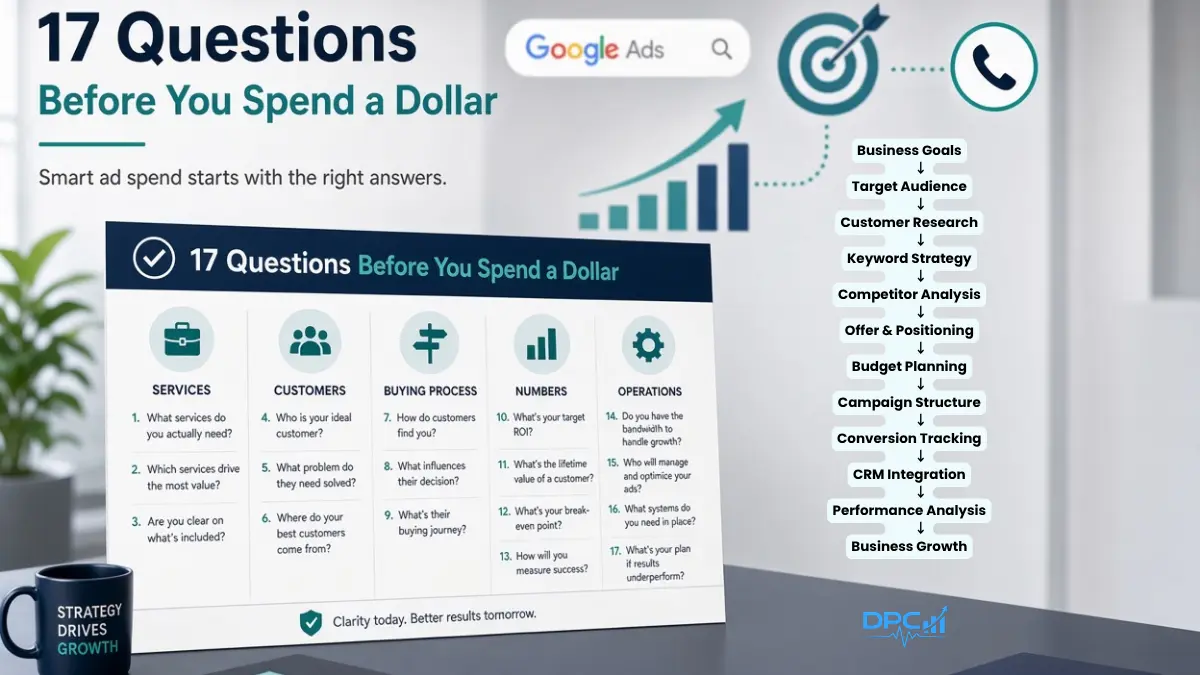
Before we touch a single keyword for a client, we run through a discovery framework — 17 questions across five categories. It takes one call to gather, and it changes almost everything about how the account gets built. Here’s the exact framework, and why each question earns its place on the list.
Why Client Discovery Is the Step Everyone Skips
Ad platforms make it dangerously easy to launch fast. Google will happily let you go live in 20 minutes with a Smart Campaign and zero context about the business. The problem is that speed to launch has nothing to do with speed to profit.
A campaign built on assumptions optimizes for the wrong thing from day one — and by the time the data shows it, you’ve already spent weeks and a chunk of budget proving a hypothesis nobody should have tested in the first place.
The fix isn’t complicated. It’s just a conversation that most agencies are too eager to skip.
Part 1: Understand What You’re Actually Selling
Before any campaign structure gets decided, you need a real map of the business — not the two-sentence version from the website’s homepage.
What services does the business actually offer?
Ask for every service, including the small ones nobody advertises. Clients routinely forget to mention services that could be genuine growth opportunities simply because “that’s not really what we’re known for.” Those forgotten services are often the ones with the least competition.
Which service is the most profitable?
Revenue and profit are not the same conversation. A service that brings in less total revenue but carries a much higher margin deserves more of the ad budget than a high-volume, thin-margin service — even if the second one “feels” like the bigger business. If a client doesn’t know their margins by service, that’s worth solving in the first call, even with rough estimates.
Which service already generates the most leads?
This tells you what’s already working — organically, by referral, or from past marketing. But lead volume on its own is a vanity number. Pair it with close rate before drawing any conclusions (more on that below).
Which service does the client actually want to sell more of?
This is the client’s strategic priority, and it can conflict directly with what’s most profitable or highest-volume. Part of the job as a strategist is finding where “what they want to sell” and “what actually makes money” overlap — and having an honest conversation when they don’t.
Part 2: Know the Customer and the Geography
Who are the ideal customers?
Not “everyone.” Ask the client to describe their best customer ever — the one who made the job easy, paid well, and would be worth cloning. That description shapes ad copy, audience settings, and even which keywords are worth bidding on versus filtering out.
Which locations bring the most valuable customers?
Geographic bid adjustments are one of the most underused levers in Google Ads. Some neighborhoods or service zones consistently produce bigger jobs, better-fit customers, or less competition than others. If a client has stopped serving certain areas because the leads weren’t worth it, that’s exactly the kind of insight that should shape geo-targeting from day one — not something discovered three months into a campaign.
Part 3: Understand How Customers Actually Buy
Do they need call leads or form leads?
This single answer determines the entire campaign type. Call-heavy businesses — emergency services, older demographics, high-urgency categories — need call tracking, call-only campaigns, and call extensions front and center. Businesses with a longer consideration window do better sending traffic to an optimized landing page built around a form. The mistake to avoid: assuming calls are always the better lead. A call that hits voicemail at midnight is worth less than a form submission the team follows up on first thing in the morning.
Does the business offer emergency services?
Emergency and same-day businesses — plumbers, locksmiths, urgent repair services — need a fundamentally different playbook: 24/7 call-only campaigns, “near me” and “now” keyword targeting, aggressive ad scheduling, and copy built around trust and immediacy rather than price comparison.
What’s the monthly lead goal?
This is where the conversation turns into math. Once you know how many new customers the team can realistically handle without dropping service quality, you can back into the required lead volume and budget.
Part 4: The Numbers That Actually Drive Strategy
These four questions rarely make it into a first conversation, but without them, every budget and target you set afterward is a guess.
What’s the average deal value or customer lifetime value?
Without this number, there’s no rational way to set a target cost-per-lead. A $200 job and a $20,000 contract should never be chasing the same CPA target.
What’s the lead-to-customer close rate?
This is the number that turns lead volume into a real business metric. If only one in twenty leads closes, the true cost of acquiring a customer might be twenty times the cost of a single lead — and that changes the entire budget conversation.
What’s the current ad budget, and is there past performance data?
Starting fresh and inheriting a messy account with history are two completely different engagements. Even imperfect past data tells you what’s already been tried and what already failed, which saves everyone from repeating the same mistakes.
Who are the top competitors, and what makes this business different?
This directly shapes ad copy differentiation and the core value proposition. If a client can’t clearly answer why they’re better than the competitor down the street, that’s a conversation worth having before a single headline gets written.
Part 5: The Operational Reality Check
Is there seasonality in the business?
Demand curves matter for both budget pacing and ad scheduling. A roofing company’s Q1 and Q3 numbers should never be planned the same way.
What tracking is currently in place — GA4, GTM, call tracking, a CRM?
You can’t optimize what you can’t measure. This one answer often determines whether the real first phase of an engagement is “launch campaigns” or “fix tracking, then launch campaigns.”
Can the team actually handle a spike in leads?
Scaling ad spend faster than a client’s operational capacity is one of the fastest ways to damage trust in the relationship. Leads go unanswered, response times slip, reviews suffer — and the campaign gets blamed for a problem that was never a targeting issue.
What’s the sales cycle length?
A same-day close and a three-week B2B sales cycle require completely different patience windows before anyone should be judging early campaign data.
The Full 17-Question Checklist
- What services does the business offer?
- Which service is the most profitable?
- Which service generates the most leads?
- Which service does the client want to sell the most?
- Who are the ideal customers?
- Which locations bring the most valuable customers?
- Do they need call leads or form leads?
- Does the business offer emergency services?
- What is the monthly lead goal?
- What is the average deal value / customer lifetime value?
- What is the lead-to-customer close rate?
- What is the current ad budget, and is there past performance data?
- Who are the top competitors, and what’s the differentiator?
- Is there seasonality in the business?
- What tracking is currently in place?
- Can the team handle a spike in leads?
- What is the sales cycle length?
Run through all five categories, and a generic “let’s run some ads” conversation turns into a growth strategy backed by actual numbers — the difference between an agency managing clicks and one managing profit.
Frequently Asked Questions
How long does this discovery process take?
A thorough discovery call usually takes 30–45 minutes. Missing data points (margins, close rates) can often be estimated on the spot and refined once the account is live.
What if the client doesn’t know some of these answers?
That’s common, especially with close rate and profit margin by service. Rough estimates are enough to start — the goal is directional accuracy, not perfect numbers. These get refined as real campaign data comes in.
Does this apply to small businesses too?
Especially small businesses. Smaller budgets have less room for error, which makes getting the targeting, lead type, and CPA math right from the start even more important than it is for a business that can afford to test its way through mistakes.
Every account we manage at DataPulse Care starts with this exact discovery process before a single campaign goes live. If you want a second set of eyes on your Google Ads strategy — or you’re starting from scratch — book a free 30-minute consultation and we’ll walk through it together.


Leave a Reply